Gen Chem · Sem 1 · 1-3b
IMFs & Properties

Water sits as a liquid. Air floats as a gas. The difference is the attraction between them.

Covalent bonds hold individual molecules together, but they do not decide if a substance is a solid, liquid, or gas at room temperature. That role belongs to the electrostatic forces of attraction between neighboring molecules. By the end of this page, you'll be able to identify the three types of intermolecular forces, rank substances by their strength, and predict bulk physical properties like boiling point, vapor pressure, and solubility.

Alignment
HS-PS1-3Compare the structure of substances at the bulk scale to infer the strength of electrical forces between particles. (Sub-targets PS1-3.5 and HS-PS1-3 investigation coda.)
Objective
Identify and compare London dispersion, dipole-dipole, and hydrogen bonding forces, and predict relative boiling points, vapor pressures, and solubility.
Scope
Covalent molecular compounds containing main-group elements Z ≤ 36. Focuses on intermolecular interactions; VSEPR molecular shapes are referenced only as inputs.

Core Claims

  • Bonds vs. IMFs: Intramolecular bonds hold atoms together *within* a molecule. Intermolecular forces (IMFs) are weaker electrical attractions *between* molecules.
  • IMF Types: London dispersion (LDF, in all molecules), dipole-dipole (between polar molecules), and hydrogen bonding (strongest, H-O, H-N, H-F).
  • Bulk Properties: Phase transitions disrupt IMFs, not covalent bonds. Stronger IMFs result in higher boiling/melting points and lower evaporation rates.

Intermolecular Attractions

O H H δ− δ+ δ+ H O H δ+ δ− δ+ IMF (H-bond) covalent bond

Retrieval Checklist

  • Identify the types of IMFs present in a compound.
  • Relate IMF strength to boiling points and evaporation rates.
  • Explain phase changes as spacing transitions without breaking bonds.

Inside the molecule vs between them.

To understand molecular behavior, we must distinguish between two very different electrical forces. The strong covalent bonds holding the hydrogen and oxygen atoms together inside a single water molecule are intramolecular bonds. These require massive chemical energy to break.

In contrast, the relatively weak electrical attractions that pull separate, neighboring water molecules toward one another are intermolecular forces (commonly abbreviated as IMFs). These are the forces you overcome during physical phase changes.

O H H δ− δ+ δ+ Covalent Bond Intramolecular: ~460 kJ/mol H O H δ+ δ− δ+ Intermolecular Force (IMF) Hydrogen Bond: ~25 kJ/mol STRONG: Preserved in boiling WEAK: Overcome in boiling
Solid lines = strong intramolecular covalent bonds · Dashed line = weak intermolecular attraction

When you boil a kettle of water, the steam rising from the spout is still H2O. You have not broken the covalent bonds to separate hydrogen and oxygen gas. You have only added enough thermal energy to break the weak IMFs, letting individual water molecules escape from each other into the air.

The electrostatic hierarchy.

Covalent substances experience three primary types of intermolecular forces. They are all electrostatic (opposite charges attracting), but they differ in how their charges are created and how long they last.

1. London Dispersion Forces (LDF)

Temporary, induced dipoles. Electrons are in constant motion. By chance, they occasionally bunch up on one side of a molecule, creating a brief, temporary partial negative charge (δ−) and leaving the other side positive (δ+). This temporary dipole repels electrons in a neighboring molecule, inducing a matching dipole. The resulting weak attraction is a London dispersion force (or LDF). LDF is present in all molecules. Larger electron clouds (heavier atoms or more atoms) shift more easily, leading to stronger LDF.

+ + δ+ δ− δ+ δ− temporary LDF attraction

2. Dipole-Dipole Forces

Permanent polar attractions. If two nonmetals have mismatched electronegativities, they share electrons unequally. This permanent polar bond creates permanent partial charges (δ+ and δ−). When polar molecules get close, they align so their opposite poles attract. This permanent electrostatic pull is a dipole-dipole force.

H Cl H Cl δ+ δ− δ+ δ− dipole-dipole

3. Hydrogen Bonding

Super-charged polar attraction. When hydrogen is bonded directly to nitrogen, oxygen, or fluorine (the three most electronegative elements, which also carry highly concentrated lone pairs), the electronegativity difference is massive. The electronegative atom pulls the shared electron density almost entirely away, leaving hydrogen's single proton completely unshielded. This bare, highly positive hydrogen attracts a negative lone pair on a neighboring molecule's N, O, or F. Despite the name, hydrogen bonding is not a true chemical bond; it is a very strong intermolecular force.

O H H H O H δ− δ+ δ+ δ+ δ− δ+ Hydrogen Bond

Classify Dominant Intermolecular Forces

Every molecule experiences London dispersion forces, but bulk behavior is dominated by the strongest attraction present. Sort each substance into its primary IMF category.

Thermal Energy vs. Intermolecular Attractions.

Slide the unified temperature slider from Deep Freeze (−100°C) to Boiling (+120°C), or click the benchmark markers. Watch how the exact same room temperature (+20°C) provides enough energy to vaporize nonpolar CO₂, creates moderate evaporation in acetone, but leaves water locked in a cohesive liquid pool.

Thermal Spectrum & Vapor Pressure Chamber
Temperature Dial: +20°C
CO₂

Carbon Dioxide

Carbon dioxide is nonpolar and symmetrical. It only attracts neighbors via weak, temporary London dispersion forces (~2 kJ/mol). Minimal thermal energy breaks these attractions, causing it to sublime directly into gas at −78°C at 1 atm.

Primary IMF: London Dispersion (LDF only)
Boiling/Phase Point: −78°C (Sublimes)
Current Phase: Gas Phase
Vapor Pressure: > 101.3 kPa (Gas)
Energetic Balance: Thermal energy exceeds IMF binding energy; intermolecular attractions completely overcome.
Atom Node (C/H/O)
Intramolecular Covalent Bond
Intermolecular Force (IMF)
Headspace Vapor Pressure Column

How we measure the invisible.

Because we cannot see individual molecules, we must infer their electrostatic attraction by running macroscopic investigations. Two classic laboratory tests gather this evidence: evaporation cooling curves and surface tension beads.

1. Evaporation Cooling Curves

When a liquid evaporates, it absorbs energy from its surroundings to break its IMFs. The faster it evaporates, the more rapidly it cools. A thermometer bulb wrapped in a soaked tissue will register a temperature drop. Liquids with weaker IMFs evaporate much faster, creating steeper temperature drops.

Time (seconds) Temperature (°C) 15° 22° (Room) Water (H₂O) H-Bonding · Slowest drop Acetone (C₃H₆O) Dipole-Dipole · Moderate Hexane (C₆H₁₄) LDF only · Steepest drop
Bulk scale cooling: Weaker IMFs produce faster evaporation and steeper temperature drops

2. Surface Tension Beads

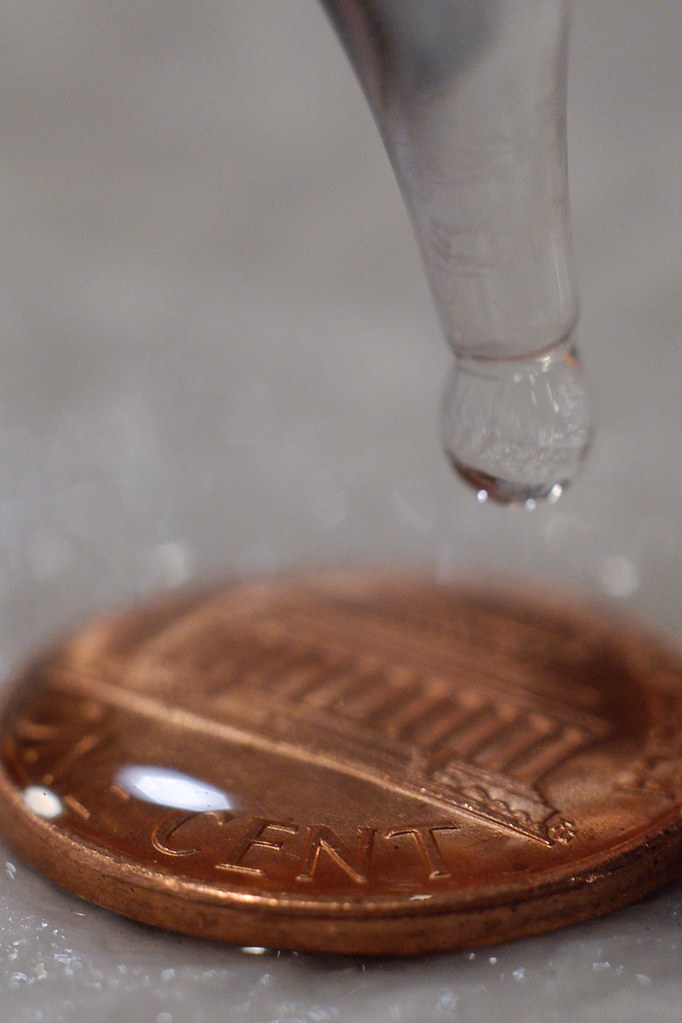
Molecules on the surface of a liquid are pulled inward by attractions from neighboring molecules below them. This inward force is surface tension. When placed on a flat coin, water molecules pull on each other so strongly that they bead up into a high, rounded dome. Acetone, with weaker forces, spreads out flat and spills off the edge.
📷 Macroscopic Observation
Macro photograph of water beading on a penny due to high surface tension
Laboratory Observation: Cohesive intermolecular attractions pull surface water molecules inward, sustaining a convex liquid bead on a coin before overflowing (Photo: “Drops on a Penny Macro” by John Flinchbaugh, CC BY-NC-SA 2.0 via Flickr).
🔬 Submicroscopic Model
Penny (Water) High Surface Tension Penny (Acetone) Low Surface Tension
Molecular Mechanism: Strong hydrogen bonds in water pull surface molecules tightly toward the bulk, while weaker dipole attractions in acetone allow the liquid to spread flat.

3. The IMF Causal Chain

Connecting molecular structure to bulk physical properties requires a rigorous five-step reasoning chain. Walk through this comparative case study of two structural isomers with the same chemical formula (C₂H₆O): ethanol and dimethyl ether.

Ethanol (C₂H₅OH) Molar Mass: 46.07 g/mol H₃C CH₂ O H Key: Polar -OH Group Dimethyl Ether (CH₃OCH₃) Molar Mass: 46.07 g/mol H₃C O CH₃ Key: C-O-C Ether Linkage
The Causal Chain: Submicroscopic structure directly dictates macroscopic bulk behavior

Consider three molecules of similar size: methane (CH₄, nonpolar), hydrogen chloride (HCl, polar), and ammonia (NH₃, polar with N–H bonds). Rank them in order of increasing boiling point.

Why

CH₄ (LDF, weakest) < HCl (Dipole-Dipole, moderate) < NH₃ (Hydrogen bonding, strongest). Because methane is nonpolar, its molecules are attracted only by weak London dispersion forces. It boils at a very low −161°C. Polar HCl molecules align to pull dipole-to-dipole, boiling at −85°C. Ammonia's polar N–H bonds form strong hydrogen bonds, requiring the most thermal energy to break, leading to a boiling point of −33°C.


Hexane (C₆H₁₄) is a completely nonpolar solvent found in gasoline. If you drop a nonpolar oil stain into water (polar) and into hexane (nonpolar), where will the oil dissolve?

Why

Oil only dissolves in hexane. The chemical rule of solubility is "like dissolves like." Polar water molecules are attracted to each other by strong hydrogen bonds, which squeeze nonpolar oil molecules out of the way (they cannot form favorable attractions with oil). Nonpolar hexane molecules interact with nonpolar oil molecules via LDF, letting them mix freely. This is why water alone cannot wash grease off your hands.


Diagnose the Error: A student wrote the following explanation on a chemistry quiz. Click the phrase containing the fatal conceptual misconception:

"When liquid water is heated to 100°C, thermal kinetic energy causes rapid boiling. During this phase change, added heat breaks the strong covalent O–H bonds inside each H2O molecule, separating the liquid into individual hydrogen and oxygen atoms that bubble away into the air as steam."

Fill the blanks from memory.

Stuck on a term? Tap Reveal. Memory retention requires active recall practice.

Covalent bonds inside a molecule are . The attractions between separate molecules are . Temporary attractions from shifting electron clouds are . Attractions between permanently polar molecules are . The exceptionally strong IMF that forms when hydrogen bonds directly to N, O, or F is . Stronger IMFs hold molecules tighter, leading to a higher but a lower . The inward pull on a liquid's surface that makes water form beads is .

Explain why water (H₂O) has a much higher boiling point than carbon dioxide (CO₂), even though carbon dioxide is a much larger and heavier molecule.

Explain it in plain English. Link the types of forces to the energy needed to boil the liquid.

One way to say it

Water molecules can form hydrogen bonds (O–H bonds present), which are exceptionally strong intermolecular attractions. Carbon dioxide is a nonpolar molecule and can only form weak London dispersion forces (LDF). Even though CO₂ has a larger electron cloud, its weak LDF are much easier to overcome than water's strong hydrogen bonds, meaning water requires significantly more thermal energy (higher temperature) to boil.

Write your answer first. Then grade yourself.

Give yourself a point for each idea you actually wrote down. The flag (⚑) marks the step that separates a complete answer from a partial one.

Gen Chem · HS-PS1-3 · constructed response[4 marks]

Acetone (C₃H₆O) forms dipole-dipole attractions. Ethanol (C₂H₅OH) forms hydrogen bonds. Compare the relative strengths of their intermolecular forces, predict which substance will evaporate more rapidly at room temperature, and explain how this evaporation rate relates to their vapor pressures.

Mark scheme: 4 marks
  • Identifies Ethanol forms hydrogen bonds (strongest IMF type) and Acetone forms dipole-dipole forces (moderate IMF type).
  • Predicts Acetone will evaporate more rapidly at room temperature because its weaker intermolecular forces are easier for thermal energy to break.
  • Explains that weaker forces allow more molecules to escape from the liquid surface into the gas phase at a given temperature.
  • Links this to vapor pressure: the greater concentration of gas molecules above the liquid results in a higher vapor pressure for acetone. (Linking the molecular escape rate directly to the pressure exerted by the gas is the key to demonstrating bulk-scale understanding.)

Self-score: 4 = all four · 3 = missing the connection to gas pressure · 2 = relative strengths + evaporation prediction, no molecular escape explanation · ≤1 = simple definition of hydrogen bonds/dipole-dipole only.

Why This Matters

Geckos walk on glass using intermolecular forces. Geckos scale sheer vertical walls using millions of microscopic hairs (setae) on their feet. Because the hairs can get incredibly close to smooth glass, the gecko's grip relies entirely on the weak, collective attraction of London dispersion forces (LDFs).

HS-PS1-3 Practice Suite Adaptive Diagnostic · Verified PDF Seal

Adaptive Competency Practice: HS-PS1-3

Test your mastery of intermolecular forces (LDF, dipole-dipole, hydrogen bonding), bulk properties (boiling point, vapor pressure, evaporation rate), and experimental limitations one question at a time. The adaptive engine identifies individual skill gaps, provides tutoring hints on missed questions, and awards an official authenticated completion receipt.

Launch Adaptive Practice →